October 5, 2024
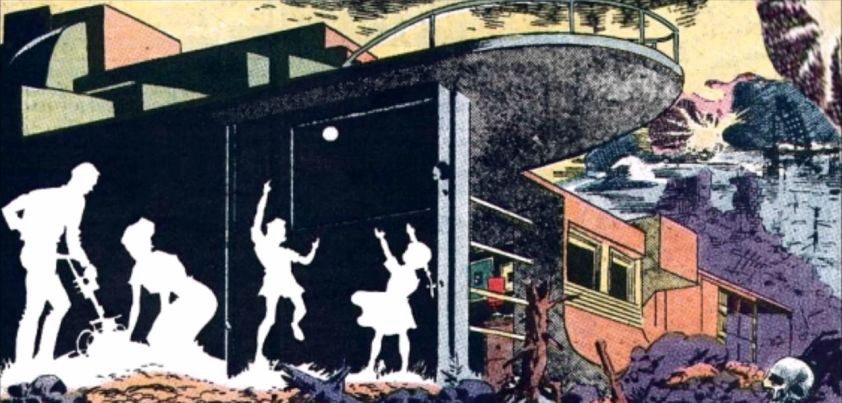
“Today is August 4, 2026, the city of Allendale, California.”
There Will Come Soft Rains by Ray Bradbury exposed readers to an anti-utopian society where technology and nature are intertwined within scientific advances. Human society has consistently developed as an amalgamation of technological and social innovations, creating new opportunities for the future. Yet, these advances may not truly be considered positive. Bradbury challenges these ideals by presenting us with a story of danger, destruction, and nature as it persists throughout time. In this essay, I will discuss the way this SF story contributes to visions and warnings, as well as the overarching theme of nature versus technology and how we can connect it to our own human experience.
Socio-technical imaginaries circulate within wider culture, bringing implicit ideas about collective futures and the common good (Chambers, Garforth 2020). There is a constant growing knowledge that feeds the imagination of potential technology. This knowledge remains available to a select few, those that hold the power of the future that is yet to be seen. Science Fiction (SF) is a perspective that can be used to visualize the current climate as it relates to the future. This helps us understand Bradbury’s story as a part of the ‘preaching’ category. “Morality pieces, prophecies, visions, and warnings, more concerned with the conduct of human society than with its techniques,” (Merril, 2017, 27). Sufficiently, we have a direct link to Bradbury— as it determines the entire premise of the text. The notion of nature versus technology displays a concern for human society which has ultimately developed into personified fears and potential terroristic qualities. We are in a situation of advancement within life-like technology which are depicted as automated intelligent functions (e.g. AI). In post-modern society, predictions have emerged regarding the upward trend of technological catastrophic effects that this may have on mankind.
Integrating these factors of technology and life, references help us understand the story better and the connections being made. In SF, there have been multiple developments made that constitute a significant part of storytelling. “The second development was the rise of ecological consciousness in the post-war period.” (Seed, 2005). Bradbury includes examples of nature throughout, igniting a thought process of said consciousness: what the world represents and how the progress of advanced technology may very well cause damage that may be unfixable. SF tends to emphasize the possibilities and threats of ascendant science and technology forms (Lockhurst, 2005). There is an exploration within the genre that often inspires new narrative modes in material worlds and social patterns. Technology has gotten to the point where we are articulating perspectives that are beyond human: Connection to the house left amongst the ruins in Bradbury’s story. As authors of defining SF can relay, we can categorize “There Will Come Soft Rains” (Bradbury, 1950) as a preaching story, a lone house surviving a nuclear bomb set in a post apocalyptic setting in California.

Preaching stories in science fiction are able to provide a glimpse of possible futures. Bradbury’s SF short creates an imagery of a house standing among ruins after everything else was destroyed. Warnings and visions against the danger of our reliance on technology remain prevalent throughout the themes presented. “Getting no answer from lonely foxes and whining cars, it had shut up its windows and drawn shades in an old-maidenly preoccupation with self protection which bordered on mechanical paranoia.” (2) The house is in connection to advanced technology which operates on its own, even though the family who was previously living there is gone. It continues to work despite this, yet it conveys its continuous distaste for nature. Technology seems to have isolated us from nature. The disconnection thereof has allowed technology to take over our lives, seeing individuals today constantly on their phones, social media on the rise, and further implications of AI technology which has become a concern even for government bodies. “The dog, once huge and fleshy, but now gone to bone and covered with soreness moved in and through the house, tracking mud. Behind it whirred, angry at having to pick up the mud, angry at inconvenience.” (2) Displaying further disconnect, the house views nature as a nuisance, in the context of cleaning and the dog as a symbol of nature. Interestingly, the house itself cannot help but clean up after the mess that is being made.
Technology has a rather divorced mind, or better yet no mind at all. Simply put, the house has an array of functions that it must oblige even with the disregard for the nature that feeds and surrounds it. Bradbury is attempting to bring the reader an awareness of functionality within technology and the way that it can be applied to consciousness. In regards to nature, Sara Teasdale’s poem emphasizes that nature will thrive even after we are all gone. The disconnect to nature backfires on the house causing it to burn down. “The room ablaze in an instant.” (4) The fire symbolizes the power of nature and its possible craving to take over the world.
Bradbury’s use of literature remains completely saturated within today’s society and technological culture.


Leave a Reply