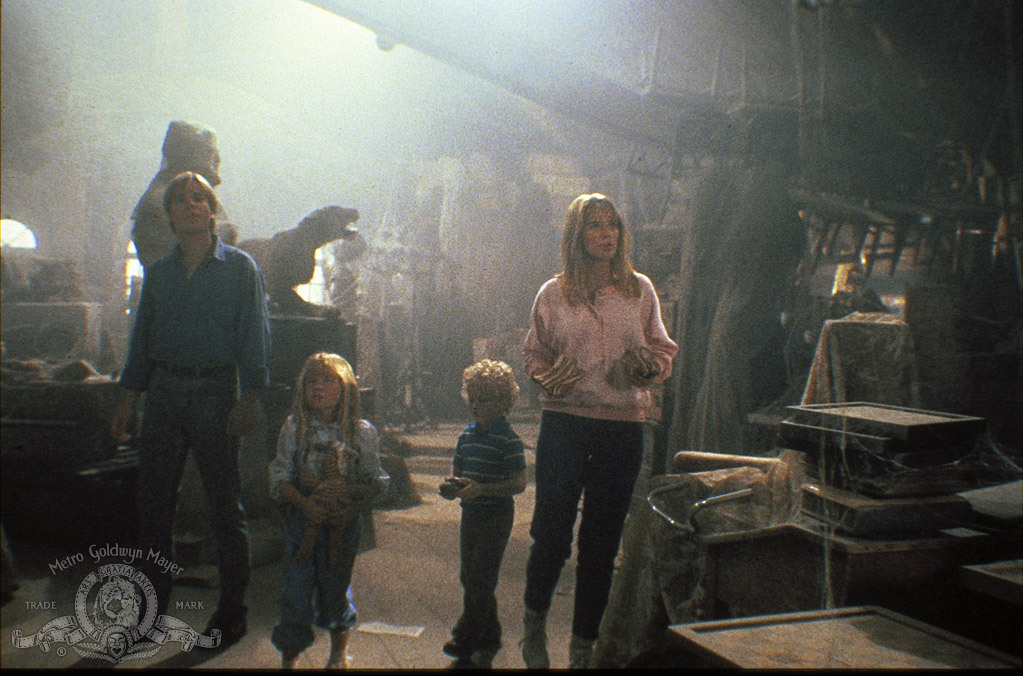
Our childhoods tend to shape the rest of our lives – More importantly, the role our mothers play truly holds the most impact. Flowers in the Attic (1987) is classified as psychological drama starring Louise Fletcher, Victoria Tennant, Kristy Swanson, and Jeb Stuart Adams. Its plot follows four youngsters who, after the death of their father, are held captive in the attic of their abusive grandmother’s sprawling estate by their cruel and manipulative mother. It is based on V. C. Andrews’ 1979 novel of the same name.In this review, I will consider the film’s adaptation and how it relates to the novel that was first written. V.C. Andrews is one of my favorite writers because she makes you feel right at home, almost like you know the characters personally. I have been deeply invested since I read Flowers in the Attic – The story is wrapped into the Dollanganger series.
To begin, the premise of this story takes place in Virginia. In a small town home lives a beautiful family, living simple lives with tender love and care. As the seasons change, there is a terrible accident that changes the course of this family’s lives forever. The children, there are three, are called the Dresden dolls. When this life altering event takes them for a dark change, Chris and Cathy along with the twins, are deeply scarred. Their mother, Corrine, is left with the decision to move back into their parents home and take the children with her. They have no choice, sheltered enough to be terrified of this change, thrusted into an entire new environment that unravels dark, family secrets. Stability plays an important role in your life, so when we are young we want to have a solid home. Things change, life happens and sometimes there are things that we cannot take back. Corrine had no choice, as a mother, but to make the decision that she did to go back to her family — the same people that disowned her for conceiving with her half-uncle.
Christopher and Cathy remain strong for their twins, Cory and Carrie. There is only so much you can do when you have to suddenly be a parent to your siblings. As the oldest, Chris was symbolic of this strength and tried the best he could to remain positive while simultaneously keeping faith in their mother. Corrine tucked her children away in the attic as she attempted to lead her sick father astray, that is from her sinful life. The children were forced to make their beds and tend to a strict religious lifestyle that held more bearings than one could imagine.
An essential character is played by the Grandmother – Crusher of souls. She plays on their innocence and threatens them with pain and insult. Corrine was merely the puppeteer that guided her own children into the arms of the devil. She dangled their lives like pieces on a chess board and failed to trim her own deceptions. Without a doubt, Cathy loved her mother – she was the spitting image of her. When things began to change, she was the first to notice the truth about Corrine. A mother that was intensely beautiful, yet riddled with arrogance and horror. This became the bastion of Cathy’s existence.
As the days, weeks, and months passed here the children lay in confusion. The world seemed small now from the barred windows that never opened, the wind that ripped softly at the doorknobs they could never turn. I think about how sad it is that they were betrayed by their own mother. Christopher begged Cathy to keep faith to no avail – there was none to be had. They come together for the sake of their own survival and plan their escape with tension. The audience can witness them come together, willingly and with fear of failure in front of their faces, to leave and never come back. It is painful to see how long they wait for the truth to only be revealed from the beginning, their mother a dreadful witch (not literally but the intensity matches) scheming to her own success – at the expense of her young children.
This film is only the tip of the iceberg for Christopher and Catherine. I personally recommend reading the first book as it is – “Flowers in the Attic” followed by “Petals in the Wind.” There are more perspectives that have been published from Christopher’s perspective and so forth but there is significance in reading the books themselves. I think the film offered a visual that was needed after such emotional investment into the words, but there is nothing better than the raw verbiage of V.C. Andrews.
 Film & Book Reviews by Ashley S.
Leave a comment